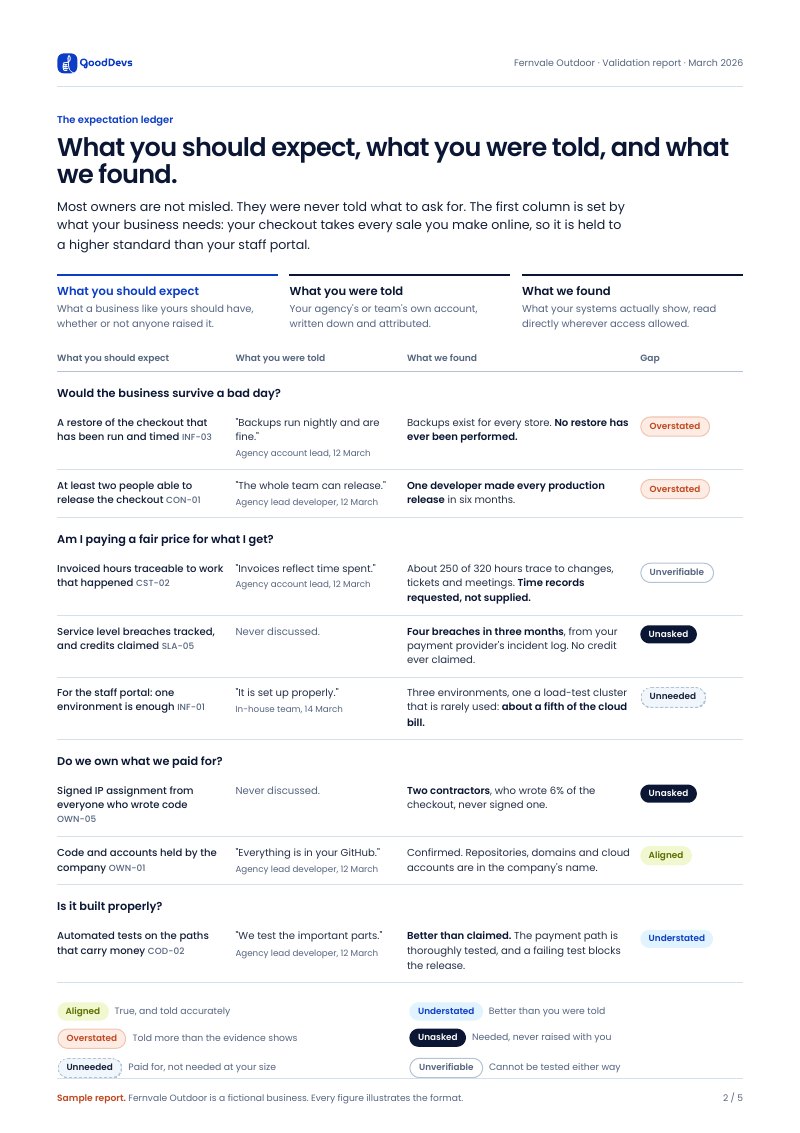
A decision sheet
One page. The question you asked, the answer in under sixty words, the three things to do in order, and the one to do this week. If you read nothing else, you still make the right call.
Anyone can hand you a list of things that are wrong. That leaves you knowing there is a problem, unable to fix it yourself, and holding a report you can only act on through the people it describes. Every finding we raise arrives with the fix attached.
Six things, every time, whatever the engagement was about. They are written for someone who does not read code and has to make a decision this week.
One page. The question you asked, the answer in under sixty words, the three things to do in order, and the one to do this week. If you read nothing else, you still make the right call.
What you should be getting, what you are being told, and what we found. Side by side, with the gap named and costed.
Every finding arrives with the fix attached: what to do, who does it, how long it takes, and how you will know it is done. Sequenced by what unblocks what.
Three to five questions you can ask without embarrassment, with what a good answer sounds like and what a worrying one sounds like.
Named specifically, so you can stop worrying about it. A review that finds only problems is not rigorous, and your team will rightly say so.
Once we have read your estate, we can tell you what moved since the last time, what has been open long enough to be a statement about the team, and what you have quietly been paying for all year.
Most people read one page, so page one carries everything that matters: the risks, what each could cost, who fixes it, and what you can stop worrying about. The rest is the evidence behind it.
PDF, five pages. A fictional business; every figure illustrates the format.
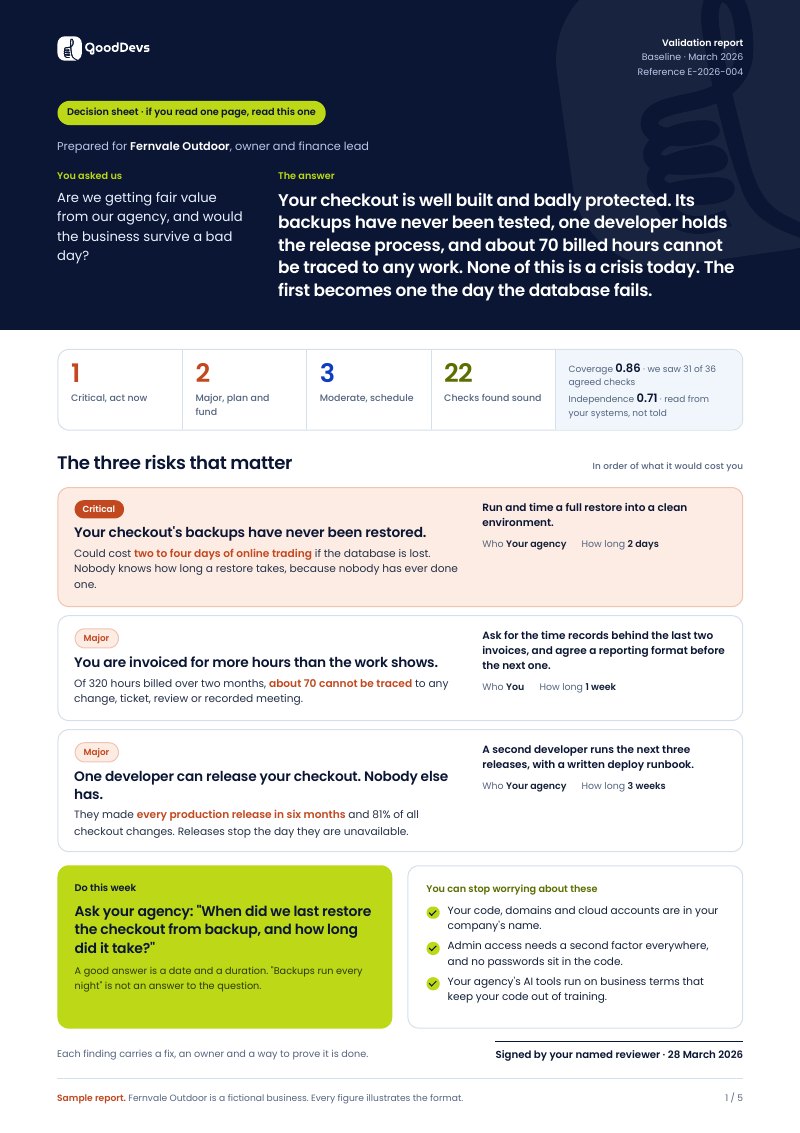
We set three things side by side that you cannot assemble on your own. The first column is the one nobody else gives you.
What a business like yours should have, whether or not anyone told you to ask for it.
Your team's own account, written down and attributed, so it can be checked rather than remembered.
What your systems actually show, read directly wherever you can give us access.
Where the three disagree, the disagreement has a name.
It works, and you were told accurately. Stop worrying about it.
Better than you were told. Your team undersold itself, and that is worth saying to them.
You were told something the evidence does not support. We put it to them before it reaches you, and print their answer.
Something your business should have, that nobody has ever raised with you. You cannot ask for what you have never heard of.
Engineering you are funding that a business your size does not need. Telling you to spend less is part of the job.
It may well be true. There is no evidence either way, and you are entitled to know which of those you are holding.
The scope changes with what is worrying you. The way the work is done does not.
Thirty minutes, no preparation, no charge. You tell us what is worrying you. Sometimes the answer is that you do not need us, and we say so.
We write down what we will look at, what we will deliberately leave out, and why. Fixed fee for that fixed scope, set against what you spend on development.
Read-only access wherever you can give it, because evidence handed to us by the people being reviewed is weaker, and you deserve to know the difference.
Anything that concerns them is put to them before it reaches you, and their answer is printed whether or not it changes our finding. It catches our mistakes at the cheapest possible moment.
A named person walks you through it and signs it. You leave with the sheet, the plan, and the questions to ask.
A problem without a remedy, an owner and a way to prove it was solved is not a shorter report. It is unfinished work, and it leaves you worse off than before you knew.
We print how much of your estate we actually saw, and how much of that came from your systems rather than from the people we were reviewing. Where we could not see enough to judge, we say that instead of rating it.
These are the questions we are able to answer. Which of them we take on is decided with you and written into the scope, along with what we are deliberately leaving out. Nobody gets all of it, because nobody needs all of it.
Do we own what we paid for?
What happens if the person who knows everything leaves?
What could hurt us, and what would it cost?
Is what we are running sound, and what is it really costing?
Does this team ship dependably?
Is the system what they describe to me?
Is what was promised what shipped?
Is the way they work costing me money?
Am I paying a fair price for what I am getting?
Who is actually working on this?
Are they using AI safely, and well?
Are they meeting what they signed up to, and could I prove it?
Could we evidence this if somebody asked?
Thirty minutes, no preparation, no charge. We work out what you actually need, scoped and priced fairly against your development budget. Sometimes the answer is nothing, and we say so.