Technical due diligence, before the price is agreed.
Whether you are selling, raising, or buying a business that runs on software, the technology is part of the price. We tell you what it is really worth carrying, in language a board can act on.
You are probably here because of one of these.
- You are preparing to sell, and want no surprises in the buyer's diligence.
- You are raising, and investors will ask what the technology is worth.
- You are buying a business whose software you cannot read.
- A lender or insurer wants evidence of your controls.
- A partner's platform is about to become part of yours.
What we look at.
Scoped to the transaction and agreed at the start, with what is out of scope written down as clearly as what is in.
Ownership and IP
Who legally owns the code, whether every contributor assigned their rights, and whether any licence could force disclosure of the source.
Key-person exposure
How much of the system depends on people who may not stay after completion.
Security and data protection
Access, known vulnerabilities, personal data and incident history, each with its consequence stated.
Technical debt, costed
What will need rebuilding, roughly what it will take, and whether it belongs in the price or in the plan.
Commercial commitments
Contracts with suppliers and service levels to customers that the buyer will inherit.
Evidence of control
Whether the business could show its controls if an auditor, lender or insurer asked tomorrow.
Every finding arrives with the fix attached.
Every risk has a figure
Each finding says what it could cost, and what would need to be true to resolve it before completion.
We show what we were not shown
The report states how much we could see, and how much was handed to us by the other side. In diligence, what cannot be evidenced is often the answer.
Adverse situations are stated
Where the other side is not cooperating, the usual right of reply can be waived, and the report says so on its first page.
What you receive
- A decision sheet for the deal team: the answer, the risks, and what must be true before completion
- An annexe written for investors, acquirers or lenders
- A plan separating what to fix before completion from what to price in
- The evidence register behind every finding, on request
We also build software. Where a fix is something we could do, the report says so and names a route that does not involve us.
Imagine receiving a report like this.
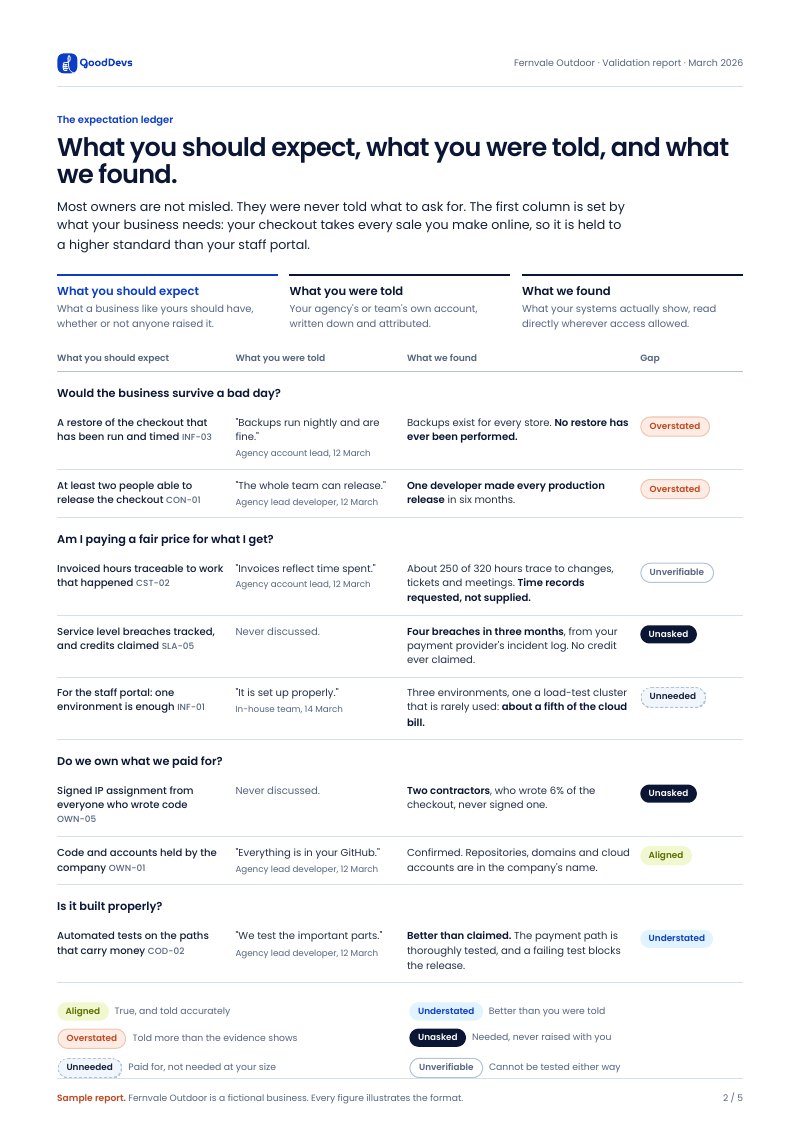
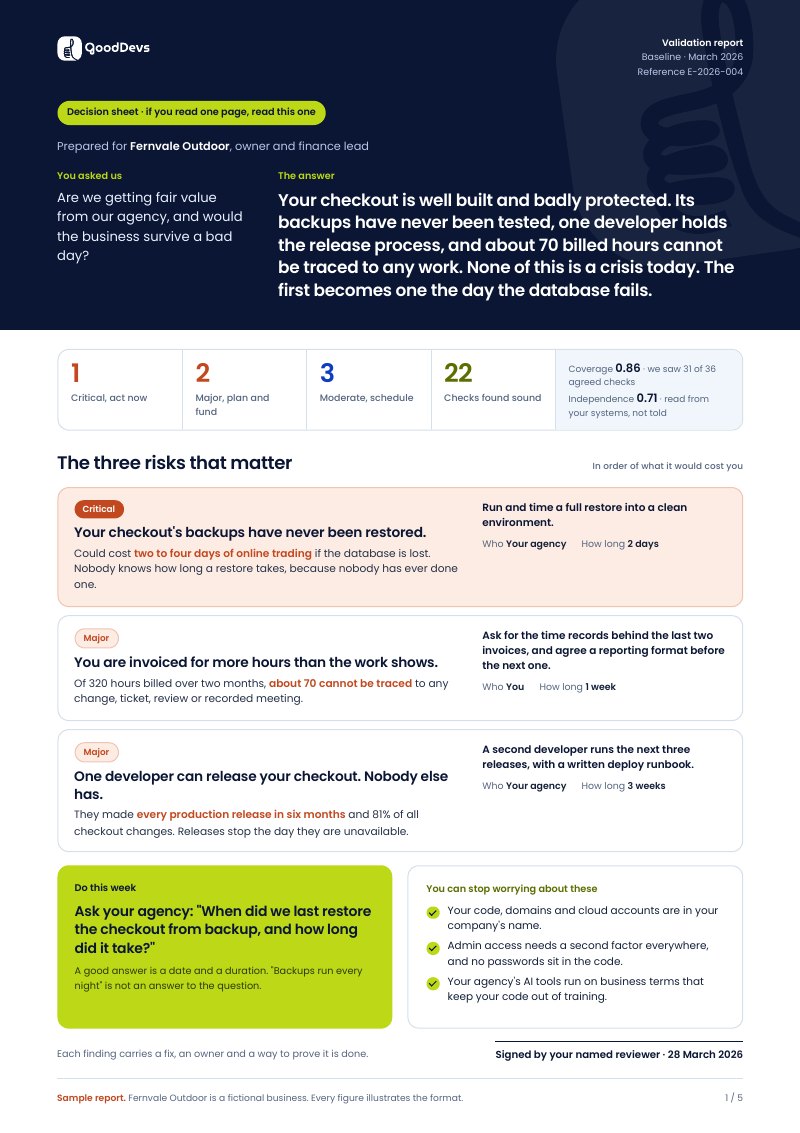
Most people read one page, so page one carries everything that matters: the risks, what each could cost, who fixes it, and what you can stop worrying about.
PDF, five pages. A fictional business; every figure illustrates the format.
Before you book.
Also: Software audit for business owners · Quote and work order check
Do you work for the buyer or the seller?
Either. Sell-side, it finds the problems before a buyer does. Buy-side, it tells you what you are really acquiring.
Is this only a code review?
No. Code is one part. Ownership, contracts, people, security and cost usually move the price more than the code does.
What if the other side will not give access?
We record what could not be seen and what that means for the conclusions. A seller who cannot evidence something has usually told you something.
How is it timed?
Scoped against your deal timetable on the first call, so the report lands before the decision it informs.
How is it priced?
A fixed fee for a fixed scope, quoted after a thirty-minute call.
Book a thirty-minute call.
Tell us what worries you. You leave knowing what we would look at, and what it would take.